The Blind Gamer Fighting to Make Every Video Game Accessible
I’d never set foot in Ross Minor’s apartment before, so when I pulled up to the building, I couldn’t shake the doubt that I’d gotten the address wrong. I double-check the text he sent me just a few minutes prior. The unit number and street check out, but when I lean in to peer through the front window, every light inside is dark— and that’s when it hits me how silly I’m being. I knock on the door instead.
It only takes a few seconds before I hear footsteps thudding down the staircase inside. Minor meets me at the threshold with a firm, solid handshake. I step over the entryway, but don’t go further— the whole place is so dim I can barely make out shapes. “Everyone complains the lighting in this place is garbage,” he says, sounding sheepish. “Give me one second.” He vanishes down the hallway, and I hear a sharp click of a light switch. “Better now?”
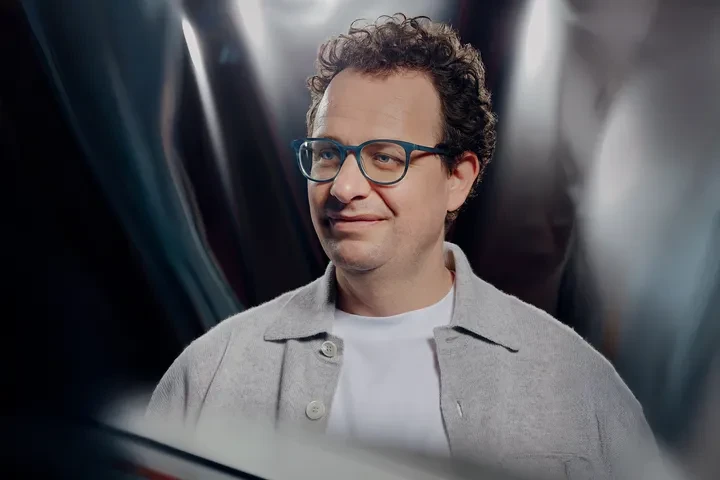
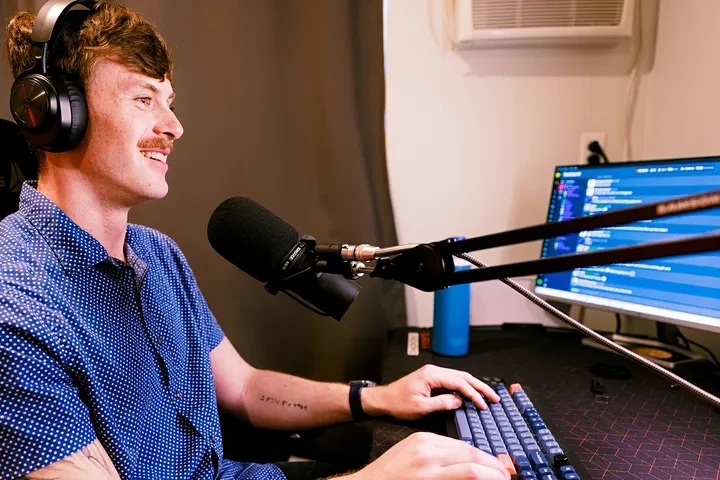
Now that the light’s on, I get a clear look at his face: square jaw, a perfectly trimmed mustache, blond hair, and warm, friendly blue eyes— even if they aren’t pointed directly at me.
I’d come to meet Minor to talk about his wildly unconventional career path— when was the last time you met a world-class competitive swimmer who walked away from the sport to build video games? But he has zero interest in hanging around his apartment. Instead, he suggests we grab pizza at a new spot nearby he’s been wanting to try. “The reviews online are incredible,” he tells me, confident we’ll love it.
We head out, and he leads the way: turn left past the grocery store, right at the corner, another right by the wine bar. A woman waiting to cross the street glances at Minor, then at the white cane he carries, and pauses to stare. She then yells past me over the roar of traffic, in a tone she probably thinks sounds warm and encouraging: “It’s so brave of you to cross this busy intersection all on your own!”
Minor smiles and shoots back, “What other option do I have?” The woman doesn’t respond. She looks away awkwardly, and Minor keeps smiling like nothing happened.
Minor wasn’t born blind. In 2006, when he was 7 years old, he and his older brother were asleep in their shared bedroom one night. Their father, enraged after his wife threatened to leave him, walked into the room and shot both boys in the head before turning the gun on himself. When Minor woke up in a hospital bed, he was told both his brother and father were dead. He couldn’t see the person delivering the news.
The bullet had entered his right temple, passed clean through the other side of his head, and ended up lodged in the palm of his hand. Along the way, it destroyed his left eye entirely and severed the optic nerve of his right, leaving him completely blind. He’d just turned eight years old a few days before the shooting.
Now 27, Minor tells some version of this story a couple times a week, almost always warning listeners upfront that it’s a heavy, upsetting tale. It’s also posted publicly on his website, which is linked across all his social media profiles. He knows people are curious, and he doesn’t mind answering their most common questions:
How do you read online reviews? A screen reader.
How do you get around? A cane, and sometimes a guide dog.
Can you actually play video games? Yes— well, sometimes. It depends on the game.
But Minor hasn’t just figured out how to play a handful of titles on his own. He’s built his entire career around one singular mission: to make every video game accessible to blind players, so anyone can play whatever they want.
To an outside observer, this goal sounds almost absurd. The word “video” in “video game” literally traces back to the Latin word for “to see.” How can a medium built entirely around visual cues ever be made accessible to people who can’t see? But Minor is already making real progress. He’s become something of a leading figure in the accessibility space, with an impressive resume of work: he’s consulted on Rare’s Sea of Thieves and Xbox’s As Dusk Falls, narrated the official audio description track for Netflix’s Avatar: The Last Airbender, and is currently working on multiple upcoming titles from major studios whose names I can’t share due to non-disclosure agreements. Thanks to work from people like Minor and a small group of passionate allies in the gaming industry, blind gamers have more accessible titles to choose from today than ever before.
Minor devotes almost all his time to this accessibility work, a luxury that not every blind or disabled activist can afford. As he puts it, he’s in an unusually privileged position: when the shooting happened, the public wasn’t as desensitized to mass gun violence and family murder-suicides as it is today. Local communities rallied around him, and fundraisers set up a college fund for him, plus a small emergency nest egg.
Even so, making ends meet is a constant struggle. Disability comes with steep, unexpected costs, and even with his odd consulting jobs in gaming, Minor still relies on survivor benefits, Social Security, and food stamps to get by. Put simply, he can barely afford to do the work he’s doing. But he still says he’s lucky just to get the chance to try.
Once we sit down at the pizza place, Minor asks me to read the menu out loud for him. If I hadn’t been there, he would have used his phone’s text-scanning app that reads menu text aloud for him. It would almost certainly have been faster, too— I’ve heard him use that app before, and he cranks the speed so high that all I can pick up is a blur of sharp consonants. He would have finished reading the entire menu before I could even get through the appetizer section.
Later, it hits me: when Minor asks a sighted person for small favors like this, it’s often for our benefit, not his. It’s a way to let us feel useful, to make us feel included in the interaction.
One of the first things you’ll notice about Minor is the huge, bright blue Gyarados tattoo covering most of his right arm. It has multiple layers of meaning. On the surface, a powerful, winged water-type makes perfect sense for a competitive swimmer. Minor took up swimming in middle school, and got so good that he earned a spot on the U.S. Paralympic team. When I first met him in 2020, he was deep in training for the Tokyo Games— that trip never happened, he dropped out after a long bout of severe depression.
But the deeper meaning of the tattoo is simple: Gyarados is a Pokémon, and the Pokémon franchise changed the entire course of Minor’s life. His connection to the games started back when he was recovering in the hospital.
“I don’t remember the exact day it clicked,” he says, setting down a slice of pizza on his plate. “It still feels like a dream, honestly. But I remember a friend from school came to visit, and all I wanted to talk about was Pokémon. So he sat next to my bed and played his copy for me, and I just listened. That’s when I realized I could actually follow what was happening, just from the sounds.”
Pokémon was never intentionally designed to be accessible to blind players. Instead, it’s what Minor calls “accidentally accessible.” Every single Pokémon has a completely unique cry that plays when it’s sent out into battle. Bird-types have light, airy chiptune melodies, while heavy rock-types have deep, bass-heavy beeps and booms. Minor had already put dozens of hours into his own copy of Pokémon Ruby before the shooting, so he could recognize many of the cries from memory.
When Minor was released from the hospital, he and his mom moved into his grandparents’ house. “My mom brought all my old stuff, including my copy of Ruby,” he says. At first, his cousin would play the game for him, and Minor would listen and tell him what moves to make. Then he asked to try it himself.
That’s when the most important accidentally accessible feature of the original Pokémon games clicked into place: the bump sound. When you’re walking around the overworld map, if your character runs into a wall or an obstacle, the game plays a distinct, recognizable bump sound. Anyone who’s played those old games can probably hear that sound in their head right now. It’s a tiny, simple detail, but it let Minor navigate the game world by “feel.” Push up three times: nothing, nothing, bump. Okay. Press right: bump. Press left: bump. Yep, that’s a dead end. Turn around.
For months after the shooting, Minor was scared of adults. He would only talk to other kids or his mom. Around the time he was re-learning to play Pokémon, an older mobility tutor came to meet him. “He brought me my first cane, but I wouldn’t even come out from under my blanket to say hello,” Minor recalls. “So he just slipped the cane under the blanket so I could feel it. That’s when he started teaching me how to use it.”
Lessons became a weekly thing. Once a week, the tutor would pull Minor out of class for a fun activity. One of Minor’s favorites was the clock game: the tutor would hide a wind-up clock somewhere in the room, and Minor had to find it by following the soft ticking. That’s how Minor learned to navigate new spaces: by exploring slowly, bumping gently into obstacles, and building a mental map of the area. The whole experience felt familiar to him. It was almost exactly like playing Pokémon.
Then a funny thing happened: the real world got easier and easier for Minor to navigate, but video game worlds got harder. Whenever a text dialog box popped up in a game, he’d have to ask his friends on the playground to read it for him. Kids haven’t gotten cynical yet, Minor says, so they never minded. But more often than not, people were only interested in him as an “inspiration”— the kid who overcame terrible tragedy to play sports, to play guitar, to just live his life. But the only thing Minor ever wanted to talk about, then and now, was video games. And almost all the games his friends were obsessed with were completely unplayable for him. Even Pokémon got harder, as newer installments moved from grid-based 2D to full 3D worlds.
But every once in a while, there was an exception. “Left 4 Dead 2 is what really showed me what gaming could be for me,” Minor says. He still remembers that day clearly: sitting on a friend’s couch in high school, playing the Dark Carnival level. Usually, his friends spent the whole game protecting him, but that level got overwhelming for all of them. Zombies swarmed everywhere. So Minor started listening for enemy sounds and swinging his melee weapon where he heard noise. After a few chaotic minutes, he heard the chime that meant the level was over. “My friends were just like, ‘Holy crap Ross, you saved us!’” he says, grinning at the memory.
“Dude, I loved that game so much. I don’t want anyone’s pity. But think about it: the whole world is built for sighted people, so I’m always asking for help. To actually be the one helping other people, instead of needing help all the time? That’s such an amazing feeling.”
When he was in his early teens, Minor stumbled across an online forum for blind gamers. Before that, buying a new video game for him was like buying a lottery ticket— the odds he’d actually be able to play it were barely better than zero. But here was a whole community: swapping tips, sharing workarounds, and just venting about how inaccessible most games are. Minor told every friend he had about it, though he assumed sighted gamers would never care.
He’d already been emailing game studios for years, asking them to add accessibility features and volunteering to help test their games. Every once in a while he’d get a polite reply saying they’d look into it. “Other times,” he says, “I’d write this whole long email pouring my heart out, and all I got back was an automated response.”
Then, during his senior year of high school, Minor did an Ask Me Anything thread on Reddit, offering to answer questions about what it’s like to live as a blind person. He expected most people would ask about his swimming career. To his shock, most people were obsessed with one thing: the fact that he could play video games. At the request of dozens of commenters, he uploaded a clip of himself playing Mortal Kombat X. Then someone offered to crowdfund an Xbox One so Minor could start streaming his gameplay online. He said yes.
That’s how Minor’s YouTube channel got started, with two clear goals: first, to share tips and tricks for other blind gamers who want to play; second, to be a public advocate for better accessibility in all games. His audience grew steadily, and today he has more than 33,000 subscribers.
As his profile grew, game developers started reaching out to him to consult on their own projects. But Minor realized his lived experience as a blind gamer wasn’t enough. He wanted to learn the actual craft of game design. He bought dozens of books on game development and read them all cover to cover with his screen reader. He got every relevant certification he could find. He tracked down mentors who’d been working in accessibility longer than him and picked their brains for advice. He taught himself how to code.
This was around the same time Minor qualified for the Paralympic team. I asked him if he ever considered using the Paralympics as a platform to get the word out about his accessibility work— win a medal, then use that fame to push for better games. Everyone listens to star athletes, after all.
Minor shook his head. “It’s still not equal for Paralympic athletes,” he says. “The Paralympics happens a full month after the Olympics. Once the Olympics are over, everyone just checks out. Nobody cares about us.” He adds, “What matters to me is reach. How many people can I actually help? That’s all that counts.”
And more importantly, Minor never loved swimming the way he loves video games. By his own estimation, convincing the game industry to prioritize accessibility for blind players is a far harder, more complicated challenge than competing at the Olympic level.
Almost all modern video games are built on pre-existing game engines— collections of pre-written code that handle basic core mechanics like gravity, character movement, and collision. If you want to make a first-person shooter, you don’t have to code how gravity works from scratch; it’s already built into the engine. Every big game from Fortnite to Pokémon Go runs on these engines, and they powered roughly 90 percent of all new games released on Steam in 2024.
In theory, these engines could easily add built-in accessibility features for blind players: automatic screen reader integration, sonar-style tools that alert players to nearby obstacles, and more. But right now, there are no mandatory industry standards for these features. The few games that are fully accessible to blind players— like The Last of Us Part II, which was the gold standard for accessibility when it launched— were built in-house on custom, proprietary engines, and there’s no financial reason for studios to share their accessibility designs with other companies.
So how do you break through decades of industry inertia? It takes a whole lot of patience, Minor says. He’s watched disability activists do this work for generations before him: you smile, and you explain the same thing over, and over, and over again.
Minor’s first ever consulting gig was on Madden NFL 18: he gave feedback on a controller rumble feature and led a workshop for the team. His name wasn’t in the game credits, he got no payment, all he got was a tour of the studio and a signed copy of the game. (The devs asked him to do more work, but he passed the gig to a friend— Minor doesn’t even like football.)
Things have gotten a little better, but this kind of treatment is still common. Studios will often dangle consulting opportunities in front of disabled gamers, then only spend an hour asking questions, hand them a gift card, and send them home. Minor told me he once got asked by a major AAA studio to travel across the city to their office to playtest a new game— the pay they offered wasn’t even enough to cover the cost of his Uber ride there and back.
It’s a careful balancing act. Minor and many other disabled accessibility advocates I’ve talked to, whether they work with blind, low-vision, mobility-impaired, or neurodivergent gamers, are often hesitant to call out studios for bad behavior. “There’s this unspoken rule that you shouldn’t bite the hand that feeds you,” Minor says. The fear is that if disabled people are seen as “ungrateful” for the little accessibility work that companies do, those companies will just walk away entirely.
And beyond that, being a good consultant isn’t enough. To keep convincing studios that accessibility is worth investing in, you have to be a public advocate— which means being a public figure, or more specifically, an influencer with a built-in audience.
One of Minor’s earliest mentors, Brandon Cole, better known online as Superblindman, was a master at navigating this tricky landscape. Cole was one of the most well-known blind accessibility consultants in the industry, and he built his reputation on being both endlessly friendly and unbelievably good at his job. When Xbox announced that its flagship racing game Forza Motorsport would be fully playable by blind gamers, no one was shocked that Cole had led the accessibility work. He also consulted on The Last of Us Part II. He posted regularly on social media, spoke at industry events, and streamed on Twitch, all to raise awareness for accessibility.
Cole died of cancer in 2024. Minor, like almost everyone in the blind gaming community, was devastated. He’d lost a friend and a mentor, and he knew that the community would look to him to step up and carry on the work Cole left behind.
Did I mention how funny Minor is? I know it’s a tired cliché to point out that a disabled person has a sense of humor, but bear with me: Ross Minor is genuinely hilarious. As we walk back to his apartment after pizza, chatting animatedly, I duck under a low-hanging tree branch. Minor… doesn’t. He walks right into it, full force. I feel awful— I should have warned him. He shakes his head, spits a leaf out of his mouth, and says, “The only thing worse than being a blind guy is being a six-foot-two blind guy.”
It’s my favorite kind of joke: sharp, a little uncomfortable, rooted in an experience none of us can ever really understand. It’s the same kind of joke I tell around my white friends sometimes, just to watch them squirm, not sure if it’s okay to laugh. I look