The Hidden Surge That Made JSOC America’s Secret War Machine
Excerpt adapted from The Fort Bragg Cartel: Drug Trafficking and Murder in the Special Forces by Seth Harp
The 2020s are on track to become one of the bloodiest decades in modern global history. Across the world—from Ukraine and Yemen to Gaza—US-backed proxy conflicts and shadow wars smolder endlessly. Washington does not typically deploy its own troops to fight these battles directly; instead, it fuels and extends them by shipping arms to warring parties, sharing intelligence with preferred proxies, and running covert operations—most notably targeted assassinations—to manipulate geopolitical outcomes on the ground.
Leading these secret American military operations is the Joint Special Operations Command (JSOC), headquartered at Fort Bragg, North Carolina. Largely hidden from public view, JSOC is nevertheless the most powerful entity within the US military, and one of the most impactful institutions across the entire US federal government. But this outsized influence is a relatively new development.
As I outline in my new book, JSOC’s rise to power did not begin with the September 11, 2001 terrorist attacks, nor the wars Washington launched immediately after the fall of the Twin Towers. Instead, the internal takeover that made JSOC the dominant force it is today traces back to the darkest period of the Iraq War, roughly five years after 9/11. By that point, the war was going catastrophically for US war planners and foreign policy leaders, and public anger at American involvement had grown so sharp it paved the way for Barack Obama’s presidential election. What follows is an excerpt detailing how this transformation unfolded.
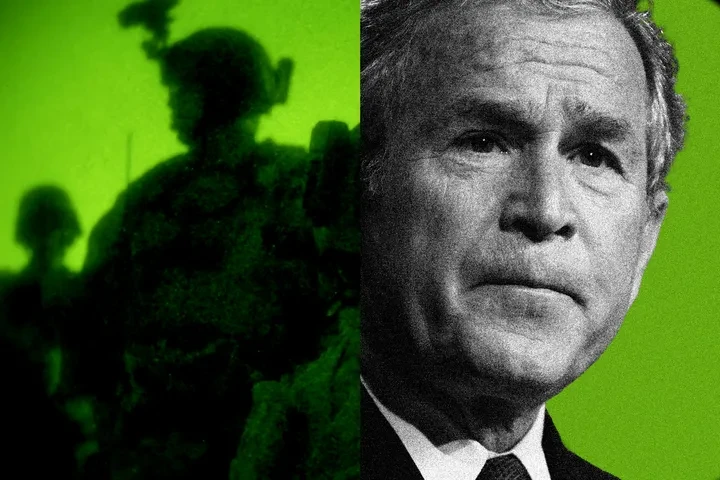
On a single day in June 2006, the Associated Press documented Iraq’s rapid unraveling across headlines: Shootings and bombings killed 12 people in Baghdad; a suicide attack at a Shia soldier’s funeral left four dead and 27 injured; seven bullet-ridden bodies were pulled from the Tigris River, while two more torture victims were recovered from the Euphrates; police in Kirkuk found the body of a teenage girl who had been raped and killed. As this wave of retaliatory bloodshed signaled Iraq’s plunge into full-blown sectarian civil war, President George W. Bush and his National Security Council assembled a new team of advisors to overhaul their failing war strategy.
It was at this juncture that a group of ambitious leaders within the US special operations community stepped forward to pitch a new approach. The framework they developed—later adopted and expanded by Bush’s successor in Afghanistan—permanently rewrote how America wages war. It also explains why Fort Bragg, not the CIA’s Langley, Virginia headquarters, has become the central hub of America’s hidden imperial power.
Stanley McChrystal, then a two-star Major General, was the driving force behind this revolution in military affairs. A West Point graduate and the son of a decorated Army general, McChrystal climbed the ranks through the 75th Ranger Regiment, groomed to lead the military’s most sensitive missions. Intelligent, shrewd, charismatic, and skilled at handling the press, McChrystal first rose to prominence as a Pentagon spokesperson, before being tapped to lead black-ops JSOC in 2003—at a time when the command only filled narrow, albeit high-stakes, roles. Aligning with the Special Forces’ longstanding focus on psychological warfare, McChrystal’s most transformative innovation was not primarily tactical or strategic—it was ideological and narrative-driven.
While foreign fighters made up a tiny fraction of Iraq’s insurgency, most hailing from neighboring Syria, McChrystal successfully convinced Washington policymakers that the opposition was not a nationalist uprising against foreign occupation, but one node of a global conspiracy of anti-American terrorists. To label this vague, inherently threatening enemy, McChrystal and his team created the name “al-Qaeda in Iraq” (AQI). JSOC analysts placed Abu Musab al-Zarqawi—a little-known Jordanian militant who had already been heavily hyped by Pentagon propagandists in the lead-up to the war, and who may not have even been present in Iraq at the time—at the head of this questionable organization that JSOC itself had done more than any group to bring into popular consciousness. To explain the lack of solid evidence of direct ties between Iraqi insurgents and Osama bin Laden’s al-Qaeda core (whose remnants were by then scattered across Pakistan and Yemen), McChrystal and his aides rebranded al-Qaeda as a decentralized network of “franchises” organized around a “blind cell” structure.
In his memoir, McChrystal belatedly admits with striking candor that JSOC’s intelligence assessments “inflated al-Qaeda’s role,” and “problematically used ‘AQI’ as a catchall designation for any Sunni group that attacked Americans.” He acknowledges this narrative was a deliberate choice to “sidestep the reality” that most Iraqi insurgents were driven by tangible, on-the-ground grievances, not Islamist ideology. There is no evidence, however, that McChrystal shared this critical caveat with President Bush, who seized on the false narrative of a flood of foreign jihadists entering Iraq to retroactively justify his already discredited case for invasion. By grossly inflating Zarqawi’s importance, McChrystal and his deputy, Vice Admiral William McRaven, convinced the Bush administration that the US could “kill its way to victory” in Iraq by dramatically ramping up a campaign of targeted assassinations. This pitch was the critical turning point that allowed JSOC to seize the power it holds today.
Another key advisor Bush tapped to overhaul his failing war strategy in late 2006 was Michael Vickers, the top Pentagon official overseeing JSOC’s parent umbrella organization, Special Operations Command (SOCOM), a post with the notoriously unwieldy official acronym ASD SO/LIC & IC (Assistant Secretary of Defense for Special Operations/Low-Intensity Conflict and Interdependent Capabilities). In his own memoir, Vickers recalls how the Bush administration discarded its existing playbook for the war and implemented a new policy that put JSOC firmly in control of the entire Iraq campaign.
The new plan relied on a two-pronged approach. The public face of the strategy was a temporary buildup of conventional troops, labeled the “surge.” But the actual escalation of the war happened entirely behind closed doors: JSOC was quietly ordered to launch a dramatically expanded campaign of mass targeted assassinations, modeled directly on the Vietnam-era Phoenix Program. Despite widespread public revulsion toward the Phoenix Program decades earlier, it was still widely celebrated as a success among Washington’s national security establishment. Where JSOC’s kill list—euphemistically named the “disposition matrix” or “joint prioritized effects list”—had once been limited to former regime officials and top insurgent leaders, it now grew exponentially to include anyone, even young people or peripheral figures, suspected of opposing the American occupation. Vickers dubs this secret campaign the “hidden surge.”
From that point on, Iraq’s war became a campaign of secret, almost exclusively nighttime targeted killings. Flush with new funding, personnel, equipment, and aircraft, JSOC transformed into “JSOC on steroids”: an industrial-scale “counterterrorism killing machine,” as both Vickers and McChrystal describe it. Where JSOC had carried out roughly 10 night raids a month at the start of the war, that number climbed to 10 raids per day at the height of the hidden surge.
McChrystal named this unrelenting pace of operations the “continuous targeting cycle.” Fluent in corporate-style management jargon like “decision cycle,” “dynamic process,” and “nodal analysis,” he was fond of pithy slogans such as “it takes a network to defeat a network,” and coined the now-famous acronym F3EAD, which stands for Find, Fix, Finish, Exploit, Analyze, and Disseminate.
Despite the clunky acronym, the F3EAD cycle is a straightforward, brutal process. It typically works like this: JSOC locates a target, kills the target and every adult man and teenage boy nearby, seizes all documents and electronic devices from the scene, uses that intelligence to identify new targets to add to the kill list, then kills those new targets—sometimes just a few hours after the first raid.
The hidden surge, led by JSOC’s Army component Delta Force, was greatly aided by the mass adoption of cell phones across Iraq in the early years of the American occupation. JSOC’s screen-filled headquarters at Camp Anaconda brought in dozens of new National Security Agency (NSA) personnel, who found it trivial to intercept unencrypted calls on Iraq’s growing mobile networks, and could even turn cell phones into remote listening devices.
Popular film and television depictions of the Global War on Terror often portray American operators and spies as fluent in local languages, capable of smoothly engaging with Islamist opponents and quoting from the Quran. But in a striking, revealing admission, McChrystal wrote in his memoir that JSOC in Iraq was “hindered by an almost complete lack of Arabic skills within our force.” That means nearly all of the Iraqis killed by Delta Force were targeted not based on the content of intercepted communications, but on pseudoscientific “nodal analysis,” tips from paid informants, and arbitrary guesswork.
“We were not death squads,” McChrystal writes. But backed by NSA intercepts, newly developed Reaper drones, and fierce Kurdish mercenaries known as Mohawks, that is exactly what JSOC became during the Iraq hidden surge, which ran through 2008. The full death toll from Delta Force’s campaign of killing, and what share of Iraq’s hundreds of thousands of war deaths came at the hands of JSOC night raids, will never be known—because no official count was ever kept. This erasure from the historical record was no accident. The “hidden surge” was never meant to be seen by the American public, who were only shown images of uniformed conventional troops on patrol, never footage of the plainclothes operatives who carried out nearly all of the nighttime killing.
“From 2006 on, 90 percent or higher of insurgent deaths were from targeted, offensive SOF operations,” a retired Delta Force Sergeant Major who served during the surge recalled. “Going out night after night, on purpose, and getting in firefights with bad guys—that job fell to us.”
Unlike conventional infantry, which patrols openly and responds to attacks, Delta Force operatives identified targets in advance from a distance, then struck by surprise, often using deceptive tactics. They disguised themselves as Iraqis with wigs, brownface makeup, and prosthetics. They posed as Red Cross staff, UN inspectors, Western businessmen, and European diplomats. With the help of female support soldiers, they posed as married couples, for example passing themselves off as teachers who had come to teach English to Iraqi children. They even copied insurgent tactics, using roadside bombs to hit targets.
The operators themselves were often bearded with long hair, called each other by their first names, ignored formal rank divisions, and wore a hodgepodge of civilian clothes. When they did wear uniforms, their unit patches were entirely fake: local police badges, US state seals, Spartan helmets, Crusader shields, the Confederate battle flag, and joking patches reading “HATCHET FORCE” or “FUCK AL QAEDA.”
No press cameras ever accompanied Delta Force on night raids. Their operations were never covered in news documentaries, and few official oral histories exist, because silence is Delta Force’s defining value. But over time, the strict rules of secrecy have loosened slightly. In recent years, many former operators have appeared on podcasts to discuss their service in the Army’s secret “special mission units,” and rare photos of JSOC operations have leaked onto social media, including images of Delta Force serving in Iraq under McChrystal.
“Several of my rotations to Iraq [were] composed of just my team and a small HQ element,” former Delta Force Troop Sergeant Major Jesse Boettcher wrote in an Instagram post dated February 28, 2022. “While I had the full force of the US government just a radio call away, there were very few of us on the ground getting dirty. Our small element was able to execute and refine the entire F3EAD cycle almost daily, with very little outside assistance.”
In the photo attached to the post, Boettcher, then in his mid-30s, sits at a table wearing soiled civilian clothes. Behind him is a whiteboard: most of the writing is redacted, but scattered words are still legible: “meeting,” “explosives,” “liaison,” “interrogation,” and “safehouse.” Taped to the wall behind the whiteboard is a grid of 55 mugshots of brown-skinned Iraqi men. Almost all have been crossed out with an X.
A second photo, posted January 19, 2022, shows Boettcher’s seven-person team, a group of unkempt white men. “It might look like a ragtag bunch of ruffians, but this crew were straight-up Pipe-Hitters,” Boettcher wrote. “Pipe-Hitter” is an obscure term of high praise in special operations circles, referring to a soldier so fearless, daring, and addicted to combat that he is compared to a crack cocaine user. “The guys in front,” Boettcher wrote of three clean-shaven, young men kneeling in the foreground, “have killed more people than cancer.”
Published by arrangement with Viking. Copyright © 2025 Seth Harp.