The Coup That Began In Lady Gaga’s Malibu Greenhouse: How Stability AI Was Remade For Hollywood
Lady Gaga never could have predicted a corporate power grab would unfold among her greenhouse plants. Then again, she was co-hosting the party with Sean Parker—billionaire founder of Napster, and Facebook’s first president.
It was February 2024, and the pop star gathered guests at her $22.5 million oceanside Malibu estate to celebrate the launch of a new skincare nonprofit. One of the organization’s trustees was Gaga’s partner, who led the Parker Foundation for his day job. In the candlelit greenhouse, lined with floor-to-ceiling windows overlooking the Pacific, Parker’s inner circle mixed with Gaga’s guests, snacking on focaccia and wood-grilled branzino while a Grammy-winning string quartet played.
Prem Akkaraju, one of Parker’s closest friends and long-time business partners, arrived in a tailored suit, his thick hair perfectly styled. The pair had known each other since Parker’s tenure at Facebook, when Akkaraju worked in the music industry. Over the years, they’d tried and failed to launch a movie streaming platform together, but pulled off a far more successful deal taking over one of Hollywood’s most celebrated visual effects studios. Lately, they’d been brainstorming a new artificial intelligence venture.
That night at Gaga’s, Akkaraju ended up seated next to an investor with ties to Stability AI—the company behind the globally viral text-to-image generator Stable Diffusion, launched in 2022. Despite its early breakout success, Stability was on the brink of collapse, the investor told him. The company was days away from running out of viable options to stay afloat. His advice to Akkaraju: You should take control of Stability and turn it into the go-to AI model built for Hollywood.
Timing couldn’t have been better. Hollywood was desperate for a working solution. Since 2022, U.S. film and TV production has dropped by roughly 40%, driven by skyrocketing domestic production costs, global competition, and prolonged industry-wide labor disputes. AI was pitched as the fix: it could speed up production timelines and slash costs by automating tedious grunt work, from translating dialogue to adding frame-by-frame visual effects to editing out stray boom mics from hundreds of shots. One day, proponents say, it could even write scripts and perform roles. Two of Hollywood’s largest unions went on strike in 2023 partly to secure guarantees that generative AI wouldn’t replace union jobs in the near term, but every major studio and streaming platform is already racing to lock in an AI strategy, with a wave of startups—Luma, Runway, Asteria—already pitching custom tools to entertainment execs.
Akkaraju saw the opportunity immediately. Stability already had the core technology; it just needed a Hollywood-focused overhaul and steady leadership. There was only one obvious question: didn’t Stability already have a CEO?
Emad Mostaque, a former hedge fund manager, founded Stability in 2020 with a grand mission: “build systems that make a real difference” solving the world’s hardest problems. By 2022, Mostaque’s priority was building a cloud supercomputer powerful enough to run a cutting-edge generative AI model. At the time, OpenAI was gaining massive traction with its closed-source models, and Mostaque wanted to build an open-source alternative—“like Linux to Windows,” as he put it. He offered his supercomputer to a team of academic researchers already working on an open-source text-to-image system, and the team jumped at the opportunity. That August, they launched Stable Diffusion in partnership with Mostaque’s company.
The text-to-image tool was an instant smash hit, racking up 10 million users in just two months. “It was fairly close to state-of-the-art,” notes Maneesh Agrawala, a computer science professor at Stanford University. Openness was the core of its success: “It allowed researchers to essentially extend the model, fine-tune it, and it spurred a whole community into action in terms of creating enhancements and add-ons,” Agrawala says. By October 2022, Stability only employed 77 people, but its global community of thousands of contributors let it compete with far larger, better-funded rivals. Mostaque raised $101 million in seed funding from top venture firms and hedge funds including Coatue and Lightspeed (he says the extra million was added for good luck), and Stability hit unicorn valuation almost overnight.
Employees who worked at Stability during this era describe Mostaque as a charismatic visionary. He spoke eloquently about democratizing access to artificial intelligence, and told staffers the company would one day solve complex biomedical challenges and even generate an eighth season of Game of Thrones. “It was an incredibly fun and chaotic startup that was throwing a lot of spaghetti at the wall, and some of it stuck really hard,” a former senior leader told reporters (like most sources for this story, they requested anonymity to speak freely about Mostaque and the company).
Mostaque was thrilled by Stability’s rapid success, but he was quickly out of his depth. “I was brand-new to this,” he says. “With my Aspergers and ADHD, I was like, ‘What's going on?’” Mostaque speaks quickly and matter-of-factly: “On the research side, we did really good things. The other side I was not so good at, which was the management side.” Two former employees say Mostaque never prioritized building marketable, ready-to-use products, and only cared about developing new AI models.
Stability’s fast success also brought intense scrutiny. In January 2023, Getty Images sued Stability AI at London’s High Court, alleging the company trained its models on 12 million of Getty’s copyrighted photos without permission. Getty filed a matching lawsuit in the U.S. weeks later, accusing Stability of “brazen theft and freeriding.”
Then in June 2023, Forbes published a bombshell report alleging Mostaque inflated his professional credentials and misrepresented the company’s business to investors in pitch decks. The story claimed Mostaque only held a bachelor’s degree from Oxford, not a master’s as he’d claimed (Mostaque says he earned both degrees, and the confusion stemmed from a clerical error on his part). The report also revealed Stability owed millions of dollars to Amazon Web Services, which provided the computing power for its models, and that Mostaque had misrepresented a standard cloud services contract as an official strategic partnership with AWS.
While Mostaque pushed back against all the claims, investors lost confidence anyway. Four months after the Forbes story dropped, VCs from Coatue and Lightspeed stepped down from Stability’s board, a clear signal they no longer backed the company. By the end of 2023, Stability’s head of research, COO, general counsel, and head of HR had all resigned, and many of the company’s top researchers followed. Pressured by investors, Mostaque finally stepped down on March 22, 2024—just a few weeks after the party in Gaga’s greenhouse.
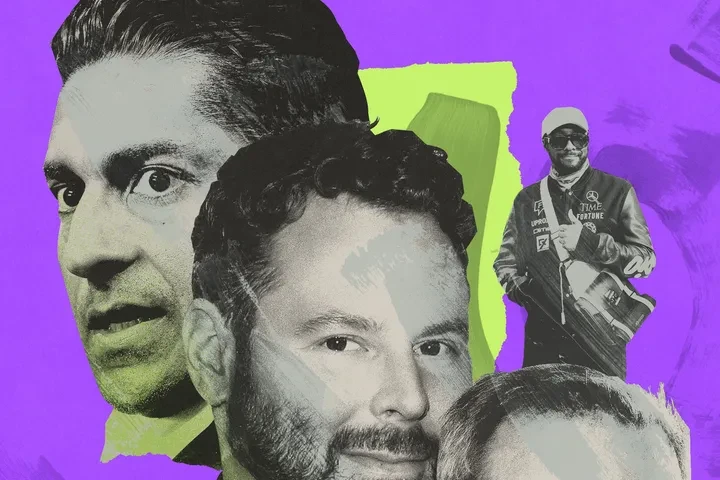
Akkaraju and Parker moved quickly to take control of Stability, installing Akkaraju as CEO and Parker as board chair. The pair never spoke to Mostaque, even though the former CEO says he reached out to offer his support for the transition.
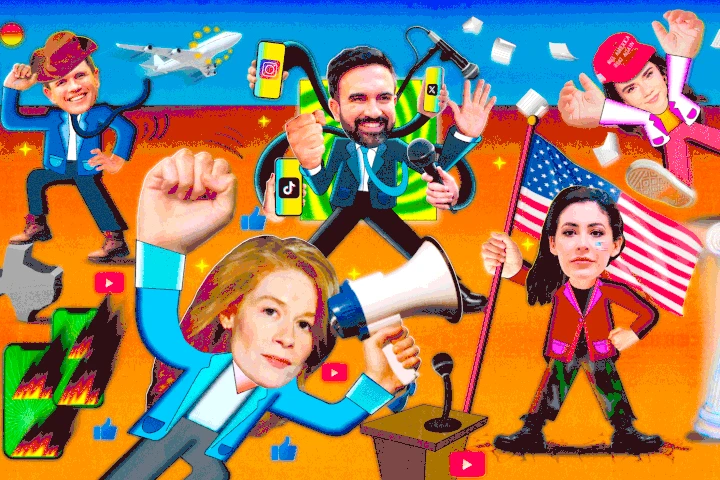
They immediately set out to remake Stability for Hollywood’s current moment. Not long after they took over, competition got even fiercer. That September, rival AI startup Runway signed the industry’s first major studio deal with Lionsgate, gaining access to the studio’s entire proprietary film catalog to use as training data in exchange for building custom AI tools for the studio. “The time it takes to go from idea to execution is just shrinking—like a lot,” says Cristóbal Valenzuela, Runway’s CEO. “You can do things in just a couple of minutes that used to take two weeks.” In the coming years, he predicts, “you will have teams of two, three, four people making the work that used to require armies and hundreds of millions of dollars.”
The Lionsgate deal pushed Hollywood’s AI transition into high gear. “I can tell you, last year when I came to Los Angeles versus today, it’s night and day,” says Amit Jain, CEO of Luma, another Stability competitor. “Last year it was ‘Let’s prototype, let’s proof-of-concept’—they were deferring the inevitable. This year it’s a whole different tone.”
Moonvalley, an AI startup founded by ex-Google DeepMind researchers (and parent company of AI film studio Asteria, co-founded by actor Natasha Lyonne), recently told Time more than a dozen major Hollywood studios are already testing its latest model—signaling growing openness to the technology, even if it hasn’t been fully adopted across the industry.
“It was really about me and Sean coming in and providing that direction, that leadership, and really taking advantage of what we call the three T’s: timing, team, and technology,” Akkaraju says.
I met Akkaraju not at a public event, but at his $20 million mansion near Beverly Hills, sitting on a plush, immaculate white couch that overlooks a perfectly manicured garden. Akkaraju is fit, with a bright smile and a tailored button-up that shows off his toned biceps, and his handshake and eye contact are equally firm.
Early in his tenure, Akkaraju says he made a deliberate choice: Stability would no longer compete with OpenAI and Google to build cutting-edge frontier large models. Instead, the company would build user-friendly tools that sit on top of those existing models, eliminating Stability’s massive, unsustainable cloud computing costs. Akkaraju negotiated new contracts with Stability’s cloud vendors, wiping out the company’s enormous debt. When asked for specifics on how he pulled off that restructuring, Akkaraju declined to comment through a spokesperson. Existing investors including Coatue have already come back to back the new Stability.
Where Mostaque pitched AI as a tool to solve the world’s biggest problems, Akkaraju is building something far more straightforward: a software-as-a-service company built exclusively for Hollywood. The goal isn’t to generate full feature films with AI, he says, but to augment the tools filmmakers already use. “I really do think that our differentiation is having the creator in the center,” Akkaraju says. “I don't see any other AI company that has James Cameron on its board.”
The irony writes itself: The filmmaker who dreamed up the murderous AI Skynet for The Terminator (an idea he had while sick and broke in Rome) now sits on the board of a major AI company. What’s even more surprising is that Cameron is working with Parker and Akkaraju, a decade after he led Hollywood’s opposition to their earlier venture. Back then, the pair launched Screening Room, a service that would let viewers watch new theatrical releases at home for $50 on the same day they premiered in cinemas. Cameron publicly pushed back, telling a CinemaCon audience he was “committed to the theater experience.” No major studios publicly signed on to the platform, and it rebranded as SR Labs in 2020.
That same year, Akkaraju and Parker acquired Weta Digital, the iconic VFX studio behind blockbusters from The Lord of the Rings to Game of Thrones to Cameron’s Avatar franchise. Weta developed the groundbreaking virtual cameras that let Cameron see a real-time render of Pandora’s alien environments through his viewfinder, just like he was filming on location.
One night, Cameron, Akkaraju, and Parker got together for dinner to talk about how technology was reshaping film. “The tequila was flowing,” Cameron recalls. “A friendship formed.” Any old tension over Screening Room melted away. (“I never really talked with him about it,” Akkaraju says. “He knew, and I knew. It was very funny.”)
So Cameron is on the board, but does Stability really put creators at the center, as Akkaraju claims? When I spoke with Parker, he emphasized the company’s commitment to open-source models and “respect for creators and respect for IP.” He added: “That sounds potentially kind of rich, coming from me, given my past association with Napster and early social media. But it is a lesson learned.”
In June, the company notched a major legal win when Getty dropped its copyright infringement claims from the UK lawsuit as the trial neared its conclusion. The U.S. trial is still ongoing. Akkaraju says the company “sources data from publicly available and licensed datasets for training and fine-tuning,” and when “creating solutions for a client” it “fine-tunes using the dataset provided by the client.” When I asked if Stability exclusively trains on free or licensed data, he responded: “Well, that’s the majority of what we’re using, for sure.”
Even AI’s biggest proponents admit that, for the most part, the technology isn’t yet ready for theatrical-level feature film work. Text-to-image tools may work well for marketing teams, but they often don’t hit the quality bar required for a major movie. “I worked on one film for Netflix and tried to use a single shot,” says a filmmaker who requested anonymity to avoid public pushback for using AI. The AI-generated footage was rejected by quality control because it didn’t meet 4K resolution standards, the filmmaker says.
There’s also the problem of consistency. Filmmakers need to tweak scenes down to the smallest detail, but most existing AI image and video generators can’t deliver that. Enter the same prompt 10 times, and you’ll get 10 different results. “That doesn't work at all in a VFX workflow,” Cameron says. “We need higher resolution, we need higher repeatability. We need controllability at levels that aren't quite there yet.”
That hasn’t stopped filmmakers from experimenting. Nearly every person I spoke with for this story says AI is already a core part of the previz process, where filmmakers map out scenes before principal photography. It has even created new kinds of inefficiencies: “The inefficiency in the old system was really the information gap between what I see and what I imagine I want moving forward,” says Luisa Huang, co-founder of Toonstar, a tech-forward animation studio. “With AI, the inefficiency becomes ‘Here's a version, here's another version, here's another version.’”
One of the first Hollywood creators to openly use generative AI in final footage is Jon Erwin, director and producer of Amazon’s biblical epic House of David. He became interested in the technology while filming the show’s first season in Greece. “I noticed that my production designer was able to visualize ideas almost in real time,” he says. “I was like, ‘Tell me exactly how you’re doing what you’re doing. What are you using, magician?’”
Erwin started testing the tools himself, and said he felt “directly tethered to my imagination” in a way he never had before. Eventually, he presented a plan to Amazon outlining how he’d use generative AI in production, and the streamer supported the idea.
“We film everything we can for real—it still takes hundreds of people,” Erwin tells me. “But we’re able to do it at about a third of the budget of some of these bigger shows in our same genre, and we’re able to do it twice as fast.” A burning forest scene in House of David would have been too expensive to pull off with practical effects, he says, so AI generated the footage audiences see on screen.
Erwin says he’s spoken with Stability’s team but has “not been able to use their tools successfully on a show at scale.” That comment lines up with what I found in my reporting: while many filmmakers have experimented with Stability’s text-to-image tools, none are using them professionally yet.
The taboo around studios openly embracing AI is starting to fade, though. In July, Netflix co-CEO Ted Sarandos told investors the streamer had allowed “gen AI final footage” to appear in one of its original series for the first time. He said the decision sped up production tenfold and cut costs dramatically. “We remain convinced that AI represents an incredible opportunity to help creators make films and series better, not just cheaper,” he said.
Hanno Basse, Stability’s chief technology officer, recently showed me a demo of the company’s new tools: he pulled up a 2D photo of his Los Angeles backyard, a grassy lawn framed by tall hedges, rose bushes clustered by a bay window, and a tree in the far left corner. Suddenly, the 2D image unfurled into a fully immersive 3D scene. A generative AI model filled in all the gaps, estimating depth (how far the hedge is from the rose bush, the tree from the window) and other missing details to make the scene feel lifelike. Basse can replicate any camera movement by selecting from a drop-down menu: zoom in or out, pan up or down, spiral around the space.
“Instead of spending hours or days or weeks building a virtual environment and rehearsing your shots, the idea here is actually that you can just take a single image and generate a concept,” Basse says.
Rob Legato, Stability’s chief pipeline architect, smiled as he watched the demo. A veteran VFX specialist who worked on The Wolf of Wall Street and Avatar, Legato joined the company in March. He’d stayed up until 2 a.m. the night before working on a film shoot, and came to the meeting as both an executive and a beta tester for the new tool.
The only issue, Legato pointed out, is the drop-down menu for camera moves. “You probably want to combine them and have a slider,” he said.
Stability’s new tools are still in their early days. Even Legato admits the virtual camera tool we tested still has a long way to go before it’s ready for professional use. “Right off the bat my job is unfortunately to be critical,” he says.
The conversation turned to rotoscoping, a tedious VFX process where artists trace over footage frame by frame. Legato explained that the work used to take hundreds of hours and was almost always assigned to entry-level animators. Now AI can automatically isolate parts of an image and add VFX in seconds. “You’d never want your child to work on roto,” he told me.
The comment was meant to be optimistic, but it cuts straight to the biggest fear around AI’s impact on Hollywood: that the technology will lead to mass job losses for artists and crew.
“I hear artists at VFX companies say, ‘Hey, I don't want to get replaced.’ Of course you don't want to get replaced!” says Cameron. “If you guys are going to lose your jobs, you're going to lose your jobs over the work drying up versus getting bumped aside by these gen AI models.” The argument, echoed by Akkaraju and Parker, is that as production gets cheaper, more projects will get greenlit, so overall industry employment will rise.
When pressed on this point, Akkaraju falls back on a common tech industry metaphor. “Every major transition or technological invention is always met with apprehension at first, and then acceptance, and then it's obvious,” he says. “When ATMs rolled out in the ’80s, all