The AI Race to Build New Drugs Faster, and Keep a Promise to a Mother
Most breakthrough new drugs trace their origins back to a personal tragedy.
Peter Ray knows this truth better than most. Born in what is modern-day Zimbabwe, to a mechanic father and a radiology technician mother, Ray fled with his family to South Africa amid the Zimbabwean War of Liberation. He still remembers that 1980 journey, traveling in a convoy of armored vehicles. As the scorching sun beat down on the trucks, a soldier taught 8-year-old Ray how to fire a machine gun. But their trip kept getting interrupted: his mother was unwell, far too unwell to keep moving.
Doctors in Cape Town gave her a cancer diagnosis. Ray still recalls accompanying her to every radiation appointment, the cold sterile hospital rooms, the awkward, constant presence of colostomy bags. His mother had always loved the beach, walking the thin line where ocean waves met sand, but as her illness progressed, even those short walks became too much. Sometimes, when she came home from the hospital for a break, it seemed like she might turn a corner. Ray would let himself hope, only for that hope to shatter when her condition worsened again. By the mid-1980s, every available treatment—surgery, radiation, chemotherapy—had been tried and exhausted. When she lay on her deathbed, 13-year-old Ray made her a promise: he would find a way to make a difference, somehow.
Ray kept that promise. He studied to become a medicinal chemist, first in South Africa where he took out student loans to cover his tuition, then at the University of Liverpool. He worked for drug companies across the United Kingdom on dozens of research projects. Now, at 53, he is one of the lead drug designers at Recursion Pharmaceuticals, a biotech firm pioneering new approaches to drug discovery. He thinks about that promise to his mother every single day. “It’s been with me my whole life,” he says. “My goal is to get life-changing cancer drugs to market.”
The urge to keep your own personal tragedy from touching someone else is one of the strongest motivators in science. But traditional drug discovery has always been a grueling, glacial slow process. It starts with chemists like Ray zeroing in on a biological target, almost always a protein—a long chain of amino acids twisted and folded into a complex 3D shape. They pull up a model of that protein on a computer screen, watching it rotate against a black void, mapping the curves and crevices on its surface: these are the spots where a small drug molecule can latch on, like a spaceship docking at a station. Then, atom by atom, they set out to build that perfect docking molecule.
Once a new molecule is designed, chemists pass it to biologists, who test it on living cells in temperature-controlled lab spaces. More often than not, setback strikes again: many cells die for reasons no one can immediately explain. Biology is infinitely complex, and the new drug almost never works as expected on the first try. Chemists have to build another, and another, tweaking and adjusting for years on end. Keith Mikule, a biologist at Insilico Medicine, once shared his experience working at an earlier pharma job: after five years of relentless work, their most promising molecule turned out to have unforeseen dangerous side effects that killed the entire project. “We had a huge team of chemists, a huge team of biologists, we made thousands of molecules, and we had nothing real to show for it,” he says.
Only the luckiest teams get a molecule that works as intended in lab mice. Even then, they only get a shot at testing it in a small group of healthy human volunteers, called a Phase I trial. If those volunteers stay healthy, the drug moves to Phase II, where it is tested on a larger group that includes people living with the target disease. If the patients don’t get worse, it moves to Phase III, the final large trial where it is tested on hundreds or thousands of diverse patients.
At every single stage of this process, huge numbers of drugs get dropped for reasons that are hard to understand and even harder to predict. More than 90% of all promising drug candidates fail along the way. If you ask a drug hunter if they’ve ever had a drug make it all the way to market, the answer is almost always no. “It’s extremely rare,” says Mikule, who only has one approved drug (niraparib, for ovarian cancer) to his name. “We’re unicorns.”
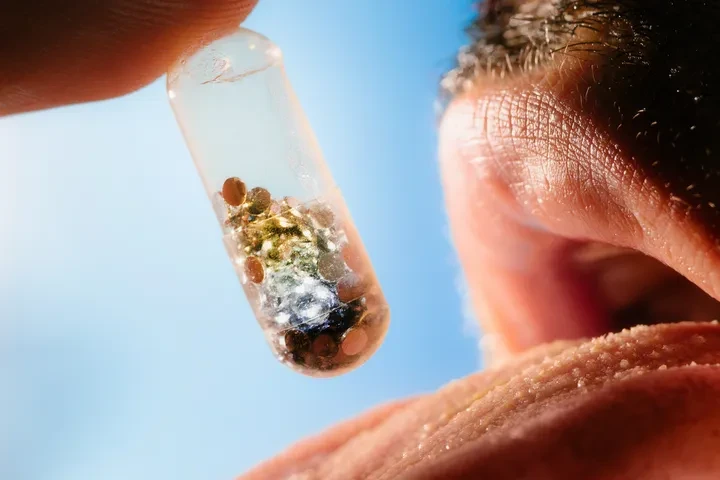
But Mikule, Ray, and a growing group of chemists and biologists are testing a radical new approach to speed this process up. When I sat down with Ray recently, he was eager to show me a molecule he and his Recursion colleagues have been developing: a MALT1 inhibitor, designed to stop the growth of blood cancer cells. On his screen, REC-3565 looks like a chain of rings and lines, another skeletal “spaceship” floating in the digital void. But it’s not just a digital design: just a few weeks before our conversation, the first Phase I volunteers had already swallowed it as a small pill. What makes REC-3565 special isn’t just that it’s survived the brutal trial gauntlet so far. Ray says it “never would have been designed by humans alone.” His team could never have made the logical leaps needed to create this molecule without the help of artificial intelligence.
As big pharma rushes to integrate AI into their work, Recursion is one of a growing group of startups betting their entire business on this technology. Founded 12 years ago by academics based in Utah, Recursion first made its name by imaging cells under hundreds of different biological conditions, building a massive database of these images, and using AI to sort through the data to find potential new drug targets. Last year, Recursion acquired Exscientia, a 10-year-old startup (and Ray’s former employer) that pioneered the use of AI to design small molecule drugs. Other leading players include Insilico Medicine, Mikule’s employer founded in 2014. Just last year, Xaira Therapeutics launched with $1 billion in venture capital, the biggest biotech funding round in years. The only other new startup that raised that much in 2024 was Safe Superintelligence, co-founded by a former senior OpenAI researcher.
Right now, no AI-designed drugs have been approved for sale to patients. But both Recursion and Insilico already have candidates that have passed Phase II clinical trials, proving they are safe for human use. Recursion’s REC-994 targets cerebral cavernous malformation, a condition that causes dangerous lesions in the brain, while Insilico’s ISM001-055 treats idiopathic pulmonary fibrosis, a progressive, fatal lung disease. Dozens more AI-linked drug candidates are in development across Recursion, Insilico, and other companies, including Ray’s REC-3565.
Right now, all these candidates are like face-down cards on a poker table. No one knows yet if AI can help create safe, effective drugs faster and cheaper than traditional methods—or if drug hunters are just about to be dealt another losing hand.
This isn’t the first time technology has been hailed as the solution to drug discovery’s problems. Back in the summer of 1981, a Fortune magazine cover headline declared the age of digital drug discovery had arrived. The story explored how scientists were using early computer visualization to pick the best molecules to test in cells, hoping to break through the industry’s slow progress. Derek Lowe, a veteran medicinal chemist who writes the long-running industry blog In the Pipeline, recalls that the article made many old-school drug hunters nervous. At Schering-Plough, where he worked at the time, the company had a room labeled “Computer-Aided Drug Discovery (CADD)” stuffed with expensive new equipment. “The medicinal chemists across the hall didn’t think much of that,” Lowe told me. “So they put a sign over their door that said ‘BADD: Brain-Assisted Drug Discovery.’”
Computers did eventually revolutionize every part of drug discovery. But the hardest problems of finding new drugs didn’t disappear with a click of a cursor. Veteran drug hunters still talk about combinatorial chemistry, an old approach that tried to find new drugs by randomly assembling molecular building blocks, with a healthy dose of skepticism. It never worked, in large part because the cost of this brute-force approach was crippling. Computational chemistry, which lets scientists simulate how a target protein and a drug molecule will interact, eventually gained slow acceptance—but its success still depends on accurate lab-derived models of targets and candidates, which require old-fashioned hard work to create.
If anything, the problems have gotten harder as we’ve learned just how complex biology really is. “We have more things to worry about than we used to,” says Lowe. Cancers driven by different genetic mutations respond to different treatments, and drugs that bind to a certain heart-linked receptor are now automatically discarded if they show any affinity for it, no matter how promising they are otherwise.
Karen Billeci, a principal biologist at Recursion, still remembers one of the first times she heard a drug hunter talk about artificial intelligence. It was dawn in 1993, and she was walking across her company’s parking lot on the edge of San Francisco Bay with a few colleagues. They worked at Genentech, the scrappy startup later acquired by Roche for $47 billion. Billeci’s programmer friends were testing whether neural networks—an early form of machine learning—could find patterns in patient data to explain why some patients responded to a drug and others didn’t. “These great drugs would go into human trials, and they’d fail,” Billeci says. They stood in that parking lot wondering if, one day, there would be software that could see patterns humans couldn’t. “We didn’t say ‘train’ [the model] back then,” Billeci recalls. “We didn’t even have the words for it yet.”
Over the next 30 years, it gradually became clear that AI could do more than just sort through patient data. Everything changed in 2020, when Alphabet DeepMind’s AI won a global protein folding competition by correctly predicting how a protein would fold into its final 3D shape—one of biology’s classic hard problems, and a core task for drug discovery. DeepMind’s AI beat every other contestant by a wide margin. David Baker, a University of Washington biochemist, was inspired to double down on using AI to design new drug proteins, work that later won him the 2024 Nobel Prize in Chemistry. “It didn’t take us long to develop methods that were far better than anything we’d had before,” he says. (Baker is also one of the founders of Xaira.)
After that breakthrough, the question became: what else can AI do? What if you feed AI every drug that has ever existed, plus all the data on how they work, and let it search a database of untested molecules to find new promising candidates? What if, as we’re asking in 2025, AI can ingest a huge chunk of all the biological knowledge humanity has ever generated, and suggest entirely new lines of research that no human ever thought of?
Sometimes, when AI is trained on human data, it produces results that look good at first but turn out to be nonsensical combinations of ideas—nothingburgers that don’t work in real life. But because drug discovery requires extensive real-world testing at every stage, it’s very unlikely that bad AI suggestions will make it far through the process. The biggest risk of AI hallucinations is just wasted time and resources. But since the traditional failure rate for new drugs is already so high, scientists at these AI startups think the risk is worth taking.
Peter Ray looks at the MALT1 inhibitor model on his screen and points to one change AI made that no human on the team thought of: it removed a section of the molecule that would have caused dangerous toxicity. “If I can get a drug to market, I’ll feel like I’ve kept my promise to my mom,” he says.
The real question is whether AI-designed molecules are actually more likely to get approved for market. The final stages of drug development are the most expensive and the most unpredictable. Carol Satler, vice president of clinical development at Insilico, says even the best designed drug hits a wall when it comes to recruiting the right trial participants. It’s slow, and she constantly worries she’s made the right choices—contacting the right doctors, excluding patients who won’t benefit, including those who will—just to see what the drug can do. By the time a drug reaches clinical trials, it already represents a billion dollars in investment and a decade of work for hundreds, if not thousands, of scientists. One patient signs up, then another. Months pass. Time crawls. “The meter is always running,” Satler says. “It’s so expensive.”
Late last year, shortly after Recursion closed its acquisition of Exscientia, more than 300 drug hunters from both companies gathered at an event space in London. The pink-lit conference hall was buzzing with news of an announcement made just days earlier by Recursion’s chief scientific officer: REC-617, a candidate developed by Exscientia, had been given to 18 terminal cancer patients whose disease had stopped responding to all other treatments. The Phase I trial was designed to test both if patients could tolerate the drug and if it had any effect. One patient—a woman with ovarian cancer that had relapsed three times—surprised everyone: she was still alive six months after starting treatment. Because the trial is blinded, no one at Recursion or Exscientia knows who this woman is or if she is still alive today. But in that room, her story felt like a spark of hope.
The announcement also included a key detail that highlighted AI’s power: because Exscientia used AI to narrow down candidate molecules before any were actually made, only 136 molecules were manufactured and tested in cells, not the thousands that would be required for traditional discovery. (Ray’s MALT1 inhibitor only required 344 molecules to be made, also a tiny fraction of the traditional number.) Recursion co-founder and CEO Chris Gibson emphasized that number in his talk to the crowd, pointing to the massive savings in time and resources. The logic is simple: by failing faster, using AI not just to invent new molecules but to rule out bad candidates early, it’s possible to cut the cost of the early stages of this extremely expensive process.
In the lobby of the venue, a breakout group including Recursion chief medical officer David Mauro, Exscientia medicinal chemist Jakub Flug, and other employees stood in a circle, getting to know each other. It was something like a giant blind date: many had never met their new colleagues in person before, and they were sharing their stories and figuring out how they would work together. They took turns introducing themselves and explaining why they joined these AI-focused companies. One person said “I’m here to have fun.” Another said “I’m here because I got tired of working on something I didn’t believe in.” A third said “I’m here because I actually want to get a drug approved for market.” Everyone nodded at that.
Downstairs, Gibson talked about his long-term vision for the company. His hope is that Recursion is building the blueprint for the future of drug discovery across the entire industry, starting with the eight candidates already in clinical trials and a handful more in preclinical development. “If we’re doing this right, if we’re building a learning system, the next 10 drugs after these eight will have a higher probability of success. The next 10 after that, even higher. We keep refining this process,” he says.
I asked him about his claim from last summer that the company would soon have data from roughly 10 different candidates. He explained that this critical mass of public data is a calculated goal: since around 90% of all drugs fail, Recursion needs to show results from 10 different programs to prove their approach works. “At the end of the day, it’ll be fair to judge us by the first 10,” Gibson says. “That’s enough of an n. That’s a big enough sample size to see what this approach can do.”
One cold morning late last year, I visited one of Recursion’s automated drug discovery labs. Patrick Collins, director of automation, and Su Jerwood, a principal pharmacology scientist, gave me a tour of a room the size of a small grocery store, lined with aisles of machines encased in plate-glass. White ring-shaped lights hung over each station. “We’ve got biology on one side, chemistry on the other,” Collins said. A magnetic rail runs through all the machines, connecting robotic pipetting systems to incubator chambers. “It’s a continuous loop: design, make, test, learn, repeat,” Collins explained, pointing to shelves of bottles and powders that hold all the raw molecular building blocks and reagents humans keep stocked for the machines.
Jerwood explained that the machines process molecules that AI has already tested and vetted in virtual space, built from raw chemical components. The candidate molecules are dripped onto trays of cultured cells, and the automated system evaluates their effects. The system is new, and still has kinks to work out: some parts of the process still need human oversight, and Recursion is still figuring out how to streamline the flow of data to and from the AI. But when it’s running at full capacity, it can generate thousands of test results for scientists to review in days. The automated system has only been up and running for about a year, so it didn’t help create the candidates currently in clinical trials—but it is already building the drugs of the future.
As I looked at the pristine machines behind the glass, I asked Collins what it means now to be a scientist who loves working with molecules, who finds joy in understanding how they work. He thought back to the first time he crystallized a protein by hand, the first time he saw a drug molecule bind to it perfectly. “I was hooked for life,” he said. Traditional lab work still has its place, he added, but at Recursion the priority is getting safe effective drugs to patients as fast as possible. “We’re all here thinking about patients,” he said.
Jerwood gave me a different answer: “I’m constantly hungry to explore something new.” Standing above the automated lab, she talked about the vast regions of chemistry no human has ever explored, structures and reactions that lie beyond what we currently understand. The sun was just rising over the horizon as we talked, and she said machines will handle the routine grunt work, leaving her time to explore that new space. “That’s the untouched territory, right? Because that means I’ll have time to go looking into it,” she said. “I’ll have time to take those risks.”
For some researchers, AI’s promise goes beyond pushing scientific boundaries or even treating common diseases. Alex Zhavoronkov, CEO and co-founder of Insilico, says the company prioritizes targets that are linked to both disease and aging. For example, its idiopathic pulmonary fibrosis candidate is designed to stop lung scarring by blocking certain biological pathways, but it may also slow the aging of healthy cells. Zhavoron