The Lisa Su Interview: AMD’s CEO on the AI Race, Rivalry With Nvidia, and Why Healthcare Is Personal
If you have a meeting coming up with AMD CEO Lisa Su, here’s one critical piece of advice: Wear sneakers.
Su, the leader of one of the world’s most influential semiconductor companies, moves fast these days—and I suspect that’s always been the case. Her firm’s chips power the artificial intelligence reshaping the global economy at breakneck speed. By Su’s account, and that of nearly every industry leader, the U.S. is locked in an AI competition with China, and the rulebook for that race is constantly being rewritten. The Trump administration has repeatedly shifted its stance on which chips can be exported to China, with the latest ruling imposing a 15% levy on AMD and Nvidia chip sales to the country. Back home, Su has staked a bold claim: AMD’s newest AI chips outperform Nvidia’s, a core part of her strategy to chip away at Nvidia’s long-held dominance in the AI market.
So, if you’re meeting Su? Come ready to keep up.
Under Su’s leadership, the stalwart American semiconductor firm has reemerged as a defining force in the AI age. Even that understates her achievement: Su inherited a struggling AMD in 2014, and pulled off a 10-year turnaround that economists describe as nothing short of extraordinary. When she took over as CEO, AMD’s market capitalization hovered around $2 billion. Today, it sits at nearly $300 billion.
For all her well-documented professional wins, Su the person—what drives her, what inspires her, what irks her, where she stands politically—remains largely out of the public eye. I set out to learn those details when I visited AMD’s headquarters and labs in the hills of Austin, Texas, on a late June day where wind only served to push the sweltering heat around instead of cooling things off.
Our conversation opened with China, which accounts for nearly a quarter of AMD’s total business. Su showed no sign of anxiety over shifting regulatory rules. These days, she travels frequently to Washington D.C. to build relationships with policymakers. “We’ve come to realize that export controls are a bit of a fact of life, just given how critical the chips that we make are,” she told me. Put another way: it’s precisely because AMD’s chips are so vital to national security and global economic activity that they’ve become a core pillar of modern statecraft.
One thing that quickly becomes clear about Su: She plays the long game. Political wrangling is simple compared to the professional turnaround she pulled off at AMD.
Born in Taiwan in 1969, Su grew up in Queens, New York. Her father worked as a city statistician; her mother was an accountant who launched her own business at age 45. Su earned a PhD in electrical engineering from MIT, then held executive roles at Texas Instruments, IBM, and Freescale Semiconductor before joining AMD in 2012. She rose quickly to chief operating officer, and six months after joining, AMD’s board chairman called her and said, “It’s time, Lisa.” Su’s surprised response? “Really? That seems kinda quick.”
As CEO, Su made the savvy call to refocus AMD on the high-performance computing market. She championed chiplets, a modular approach to chip manufacturing that has delivered enormous returns. She made industry history launching the world’s first 7-nanometer data center GPU, and in recent years doubled AMD’s data center revenue in just two years. She’s locked in partnerships with tech giants including OpenAI, Meta, Google, and two of Elon Musk’s companies: Tesla and xAI. At AMD’s annual keynote this past June, OpenAI CEO Sam Altman walked out on stage to embrace Su, a public show of their partnership’s strength.
These are all impressive milestones, but AMD is still a fraction of the size of its biggest rival, Nvidia, which boasts a $4.4 trillion market cap. Comparisons between the two firms are inevitable—especially since Su and Nvidia CEO Jensen Huang are distant cousins. I was warned Su hates being asked about this connection, but I asked anyway.
During my Austin visit, Su led me on a tour of AMD’s test labs, where rows of server racks are pushed to their extremes to test performance. Engineers straightened up as Su paused at their workstations. One team surprised her with a celebratory cake shaped like AMD’s EPYC Venice processor, and Su looked genuinely delighted. She posed for a photo, then strode on to the next row of labs, moving purposefully in a pair of white Prada sneakers. As we walked, I called out questions over the loud hum of the servers: What do models like China’s DeepSeek mean for AMD’s business? Will AMD build its own large language models? What drives Lisa Su?
Later, Su invited me to join her in her chauffeured car (it wasn’t one of her Porsches, which bear license plates named after her favorite AMD chips, much to my disappointment). With the noise of the labs behind us, the conversation grew far more candid. Over the nearly 30-minute drive to our next stop, Su pushed me on my views of AI, pushed back on my skepticism, and opened up about why powering the AI revolution—especially in healthcare—feels deeply personal to her.
Q: What do you hope the Trump administration—and the general public—understand about the AI accelerators your company builds?
A: As tech companies, we all benefit from a larger user base. Limiting access to our chips by cutting off entire markets doesn’t just hurt AMD—it hurts the United States, full stop. Competitors will step in to fill that gap. The idea that blocking chip exports will halt global AI progress is wrong—AI will keep advancing no matter what. We’d much rather that global progress be built on AMD chips than someone else’s.
Q: There’s been a big push recently to reshore more semiconductor manufacturing to the U.S. What’s the most complex challenge of bringing that production back?
A: We absolutely should bring semiconductor manufacturing back to the U.S. One hundred percent. It’s critical to both our national security and our long-term economic interests. A few years ago, we had a devastating ice storm right here in central Texas. Nothing moved for days, and a few local fabs had to shut down. That’s a perfect example of why supply chain diversity is just good business practice.
Reshoring will take time, but it’s absolutely achievable. Not that long ago, people said leading-edge manufacturing could never be done in the U.S. again. Today, we’re running production of our newest server processors at TSMC’s Arizona fab, and the results are really promising. It can be done. It’s more expensive, but that’s okay. It requires a shift in mindset: you can’t always prioritize the lowest possible cost above all else.
Q: When you became CEO of AMD in 2014, did you ever expect that tech leaders like you would have to weigh in so heavily on geopolitical and social issues? Do you feel more pressure to engage with the current administration on these topics?
A: The role has definitely changed. I wouldn’t say I’m political, or that AMD as a company is political. You won’t see me weighing in on general social issues, because that’s not where I can add the most value. But when it comes to technology policy and the global role of semiconductors, yes, we have to participate. I don’t see it as increasing pressure—I see it as increasing responsibility. We need to help get the rules right, for everyone.
Q: You’re one of the most prominent women leaders in tech and semiconductors. Why don’t you think you add value on those broader social issues?
A: Maybe “add value” wasn’t the right way to phrase it. My personal opinion on those issues might be interesting to some, but it’s far more important that we get technology policy right, based on factual evidence. That’s where my expertise lies.
Q: The question everyone’s dying to ask these days is “when?” When will AMD overtake Nvidia in the AI GPU market? Ten years ago, people would’ve laughed at that idea, but today it’s a legitimate conversation.
A: When I started as CEO, people would ask me “Why would you take this job?” and I’d be totally confused. It was the best opportunity I could’ve imagined. We were a company in an industry that matters, we’d underperformed for years, and I got the chance to lead a great team to build something important. If you’d asked me what I wanted to be when I was growing up, it wasn’t “CEO.” It was “work on something that matters.”
Back then, everyone compared us to Intel, and we were constantly having to defend our position. I told my team: “We know what we can do, let’s just show the world.” That’s why I don’t love the “when will you overtake them” question. I get it, the media loves a head-to-head rivalry between two companies. But that’s not how we see our business.
Q: It’s not just a rivalry, though. AMD has a really nuanced business model, right? You still have huge numbers of customers relying on your x86 architecture and CPUs, and your data center business exploded from $6 billion in 2022 to $12.6 billion last year. But Nvidia is still the big story in AI right now.
A: My point is that I don’t really care about being compared to Intel or Nvidia. Our vision has always been that there’s no one-size-fits-all solution for computing. You need top-tier performance across the board: the best in data centers, the best CPUs, the best AI accelerators, the best for personal computing. We have a really broad product portfolio, and the total addressable market for our products is enormous—over $500 billion in the next three to four years. We have more than enough opportunity to grow on our own terms.
Q: Sam Altman appeared at your June AI event, you’ve partnered with OpenAI, Meta, Tesla, and xAI. But the reality is that these big AI companies are deeply tied to Nvidia’s GPUs, and AMD is still seen as the second option. Do you want to get to the point where you’re their primary partner?
A: Of course I do. That’s exactly where we are today with CPUs. If you ask most of these big companies, they’ll tell you AMD is their strategic CPU partner. And we absolutely expect to get to that same point in AI. But I’m not impatient about it.
Q: You don’t want to put a timeline on it.
A: Let me put it this way: When I joined AMD in 2012, Microsoft was just an early gaming partner for us. Over the last 10-plus years, we built a ton of trust, and today we co-create products together. Microsoft just announced they’re using AMD chips not just for their next-generation Xbox consoles, but across their entire cloud infrastructure. Our work with Meta followed the exact same path. I remember my first conversation with Meta’s leadership: I said, “Just give me a shot. I don’t need to tell you I’m the best in the world right now— I’ll prove it to you. I’ll be your best partner, not just on technology, but on building out your entire tech infrastructure.” That’s exactly what we’ve done.
Q: At your June event, you talked a lot about DeepSeek, the Chinese large language model that reportedly cost far less and required far less computing power to train. How are models like that shifting how you think about computing power requirements?
A: It’s just another example of how much AI workloads are evolving. A few years ago, everyone was focused exclusively on large-scale model training. Now, with the rise of reasoning models and fine-tuning, inference computing is growing faster than any other segment of the market. That’s why flexible hardware is so critical.
It didn’t change our strategy, actually—we always knew inference would become more important. So that just means our bet on that segment was the right one. We’ve already optimized our chips for memory capacity and other key features that are critical for inference workloads.
Q: Nvidia builds its own AI models and offers the NeMo framework for developers to build generative AI. How seriously are you considering AMD building its own proprietary large models?
A: We do have a team training our own AI models, but we’re not building them to compete with the big model developers. We train them to learn from the process. The more we test our own hardware on our own models (what’s called “eating your own dog food”), the more we learn how to improve our chip design. That makes our product development faster.
Q: Analysts and customers consistently praise AMD for being extremely customer-focused. But many developers say your ROCm software platform for programming AMD hardware still isn’t on par with Nvidia’s CUDA ecosystem. What specific steps are you taking to attract more developers to ROCm?
A: I agree that software is the most critical layer, because that’s what developers interact with every day. When people compare ROCm and CUDA, it’s not that one is inherently better than the other—it’s that CUDA has been around for decades. Developers have grown accustomed to that ecosystem, so we’re asking them to learn an entirely new system. That’s the biggest barrier.
Q: But developers say it’s more than just entrenchment: they say compilers don’t work as well, performance libraries are incomplete, and they want more portability.
A: That’s fair. A lot of developers are used to how CUDA does things, and they expect ROCm to work exactly the same way. That takes time to build out. But I haven’t worked with an AI customer yet that we couldn’t get up and running with strong performance on ROCm. We don’t have every single specialized kernel and library that CUDA has built up over decades, that’s true. What are we doing about it? We’re moving faster than ever. That’s the best answer.
I learned early on that you don’t have to agree with criticism, but you do have to understand where it’s coming from. Then you prioritize what to fix. There’s still a lot of work to do, but we’re hiring aggressively, acquiring companies to fill gaps, and listening closely to what developers need. We’re already making really fast progress.
Q: Meta’s Superintelligence Lab is reportedly offering nine-figure compensation packages to lure top AI talent. What impact does that kind of pay have on hiring across the industry?
A: I don’t have direct experience with that, honestly. Competition for top talent is fierce, no question. But I believe while money is important, it’s not the most important factor when attracting great people. You need to be competitive on pay, of course, but what really draws people is belief in your company’s mission.
Our stock has performed well, so our team does well, but what we sell candidates on is the opportunity to be part of something big. You’re not just a cog in the machine at AMD—you get to help shape the future of our product roadmap. If you want to work on transformative technology and make a real impact, this is the place to be.
Q: Would AMD ever offer a nine-figure package to lure a top executive or engineer to build out your software ecosystem?
A: I don’t think so.
Q: Is that because you’d have to justify it to shareholders or the board?
A: It’s because our success doesn’t depend on one single person. Don’t get me wrong, we have some incredible people. When we acquired Nod.ai, its CEO Anush Elangovan became our head of software ecosystem. He’s absolutely phenomenal, so passionate about the work that he’ll follow up with every single developer who has an issue with ROCm. That’s the kind of person we look for: people who love the work, and there are a lot of those people out there. Our success is a team effort, not a one-person show.
Q: What does “superintelligence” mean to you?
A: I think the idea that AI can make all of us more capable, that it can amplify our own intelligence, is a wonderful vision, and we’re still in the very early days of making that real.
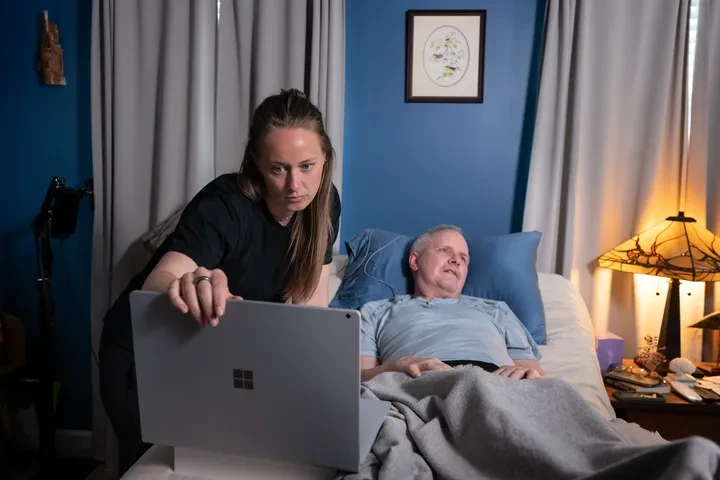
The area I’m most passionate about personally is healthcare. I’ve had firsthand experience with our healthcare system, and I know it can be so much better than it is today. We should be able to cure so many more diseases, we shouldn’t have to rely on trial and error for treatment the way we do now. AI is perfectly suited to transform this space. It can stitch together all the disconnected pieces of care, from drug discovery to treatment to inpatient care—all of it is ripe for transformation. I don’t know if you call that “superintelligence,” but that’s the kind of impact I want to see.
Q: There’s a common narrative that AI will eventually become so smart it could wipe out humanity. What do you think of those predictions? Do you believe artificial general intelligence (AGI) is possible?
A: I do believe AGI is possible, but I don’t believe AI will ever become smarter than humanity as a whole. I also don’t buy into the doomsday predictions. Technology is only as good as the people who build it, regulate it, and steer it in the right direction. I find those end-of-the-world conversations pretty esoteric. Our focus is on the here and now: the technology is good, but it’s not great yet. How do we make it great?
Q: How do you define “great” for AI?
A: Great is when AI solves really hard, real-world problems. Everyone talks about AI agents as the next big thing, but right now agents mostly handle relatively mundane tasks. Like adding items to your online shopping cart.
I think AI is going to evolve in two big directions. One is pure productivity: it takes over the menial work that people hate doing, so we can focus on more interesting, impactful work. That’s already happening, and it’s a huge win. The other direction is solving problems that would take us decades to figure out on our own. What if we could cut the time it takes to design a new chip from three years to six months? That’s the kind of great I’m talking about.
Q: But at some point, does humanity just not keep up with the pace of change?
A: I’d bet on humanity being fine. Yeah, AI feels overwhelming right now. But the thing is, when technology matures, you don’t even have to think about it. Today, you still have to double-check every answer you get from ChatGPT or Grok, right?
(Reporter note: I use ChatGPT for casual tasks, but never for reporting, and the hallucination problem is a major concern.)
Exactly. That’s the point: it’s not good enough yet. At some point, it will be good enough that you can take its answers