The Immortality Project: An Interview With Bryan Johnson, Who Says He’ll Never Die
When you first glance at the two bowls of fruit sitting on Bryan Johnson’s kitchen island, they look immaculate. Plump kiwis, firm ripe avocados, perfectly yellowed bananas fill them to the brim. For a man chasing the godlike longevity Johnson aspires to, this looks exactly like the diet of the immortally ambitious, I thought to myself. But a closer look reveals something off. Tucked next to two lemons almost entirely coated in fuzzy white mold sits a single orange, its peel dotted with mold spots. Something is rotten in the Johnson compound, it turns out.
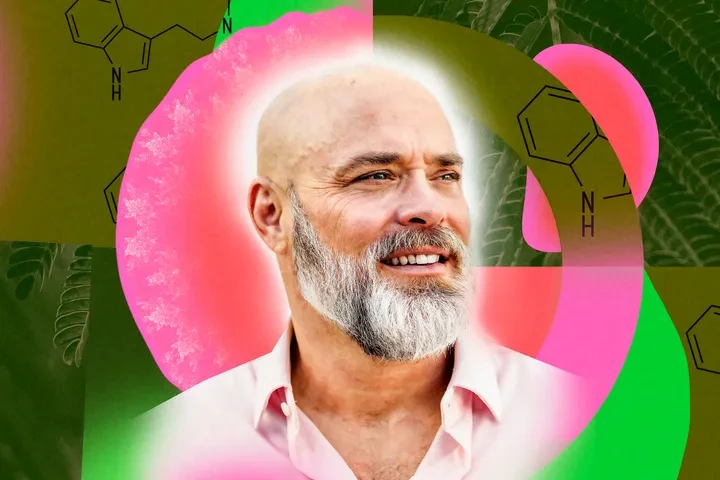
It’s worth noting that the compound itself is exactly what you’d expect. Johnson’s home in Venice, California, is that sharp-angled, concrete-floored modern template you’d immediately peg to a tech millionaire: a man who made his fortune, then walked away from his old life to hunt for a new purpose in midlife. That’s exactly who Johnson is, what he’s done, and what he’s still chasing today. After selling his online payment company Braintree for $800 million in 2013, Johnson left both his wife and the Mormon faith he’d grown up with. In 2021, he launched Project Blueprint, a personal and public mission to reverse the aging process in his own body. The all-consuming, unproven routine he follows includes everything from daily workouts and frequent blood tests to a rigidly enforced sleep schedule, regular MRIs, plasma transfusions, scalp stimulation treatments, urine tests, dozens of daily supplements, DEXA scans, light therapy, and strict caloric restriction.
If the moldy fruit didn’t tip you off, this isn’t a kitchen where families bake cookies or swap weekend stories—though a collage of candid photos taped above the stove does offer a flicker of familial warmth. (Johnson has three children, one of whom gained notoriety for sharing data about his youthful erections and donating his own plasma for his father’s anti-aging research.) This kitchen shares space with semen specimen cups and coolers storing Johnson’s blood; his walk-in pantry is neatly stacked with pills and powders that he mixes, calibrates, and consumes daily. Here, food isn’t enjoyed for pleasure—it’s a performance of optimized nutrition.
Performance, of course, is Johnson’s strong suit. First, there’s the performance of his own body, which Johnson claims is now the healthiest human body on the planet. Then there’s the performance he puts on for the public, which happens constantly. Johnson has been the subject of dozens of profiles and interviews, plus a Netflix documentary released earlier this year. He’s gained more than 4 million followers across YouTube, Instagram, and X, where he posts constant content about his (near-perfect) sleep habits, his (ultra-rigid) diet, and his (much discussed) erections. He’s also used his large online platform to push back against recent controversies: a public legal fight with his ex-fiancée Taryn Southern, and a New York Times investigation into his widespread use of non-disclosure agreements (NDAs) that bar Blueprint employees from speaking publicly about Johnson and his business operations.
Over 90 minutes of conversation, Johnson spoke at length about his longevity routine, his take on RFK Jr.’s MAHA (Make America Healthy Again) movement, and the NDAs he still enforces. He also went to great lengths to convince me—and his audience—that his work isn’t just about personal health and longer life. Like so many tech billionaires living in angular modern homes and gripped by grand visions, Johnson has a new holy grail to rally his followers around: artificial intelligence.
This interview has been edited for length and clarity.
KATIE DRUMMOND: I’m going to start with a very simple true-or-false question you can answer however you’d like. Ready?
BRYAN JOHNSON: Yes.
KATIE DRUMMOND: True or false: You, Bryan Johnson, the man sitting across from me right now, will die one day at some point in the future.
BRYAN JOHNSON: False.
KATIE DRUMMOND: Tell me more.
BRYAN JOHNSON: Death has always been seen as inevitable, so we’ve built all kinds of cultural workarounds for it. We frame immortality through professional legacies, we talk about life after death. Those are the ways we’ve coped with death up until now. But today, we have a real chance to extend human lifespans to an unknown limit. That’s just the first step. We also now have the ability to move our consciousness into computational systems. Right now, in a pretty rough early form, I already have a Bryan AI that’s absorbed every single thing I’ve ever said.
KATIE DRUMMOND: You already have this up and running?
BRYAN JOHNSON: I do.
KATIE DRUMMOND: OK.
BRYAN JOHNSON: And this Bryan AI is already pretty good. As technology gets better and better, the most valuable thing you can have will be actual continued existence. The old ideas of immortality—through legacy, kids, or an afterlife—will drop in value compared to just continuing to exist. That’s my core bet on the future.
KATIE DRUMMOND: Let’s say five years from now, you can upload your full self to an AI, and this AI Bryan is indistinguishable from flesh-and-blood Bryan. Does flesh-and-blood Bryan get to eat the cheeseburger?
BRYAN JOHNSON: Let me reframe your question. Most people today spend every waking hour chasing wealth, and any time left over goes to chasing status or prestige. Once we develop superintelligence, we can start extending lifespans to any limit: 200 years, 1,000 years, 10,000 years, even millions of years. We don’t know how far it can go. When that happens, humanity’s entire core focus shifts from accumulating wealth, status, and prestige to just continuing to exist. We might still play power games within that framework, but existence itself will become the highest good. That shift is already starting right now.
KATIE DRUMMOND: Let’s talk about your current day-to-day existence. You’ve talked a lot about your routine. Walk me through a typical day for you right now.
BRYAN JOHNSON: OK, great. I’ve built my entire life around sleep. My sleep metrics match those of someone in their early 20s, and I worked extremely hard to get that. I get exactly eight hours and 34 minutes of sleep a night. On average, I wake up less than once per night, I fall asleep within two to three minutes of my head hitting the pillow, and I have 94% sleep efficiency. Most people’s sleep patterns are all over the place, like the stock market, but mine is completely steady.
But you can’t just decide you’re going to sleep well and make it happen. You have to build your entire life around that goal. So my day actually starts the night before, when I go to sleep, and I wake up around 4:30 or 5 a.m. The first thing I do when I wake up is get out of bed— I try to be up within one minute of opening my eyes.
KATIE DRUMMOND: Within one minute?
BRYAN JOHNSON: I avoid hitting snooze for 10 more minutes, or grabbing my phone to scroll. I get up, and I get bright light in my eyes within a few minutes of waking—since I wake up before the sun, that’s 10,000 lux of artificial light. I take my inner ear temperature. Over the four years I’ve done this, I’ve noticed my baseline body temperature has dropped almost 4 degrees Fahrenheit. There’s strong evidence that species with lower basal body temperatures live longer.
Next, I apply a hair growth serum to my scalp, then scrub my scalp with a silicone brush to stimulate growth. I take a quick shower, then head downstairs. I have a morning drink, eat my first meal of the day, then work out for an hour. I do red light therapy, then hyperbaric oxygen therapy, then a session in the sauna, rinse off, and get ready for work.
KATIE DRUMMOND: That’s really an intense routine. And you stop eating for the day around… what time?
BRYAN JOHNSON: Around noon.
KATIE DRUMMOND: Let’s do a quick thing: rapid fire, you ask me some health questions, then tell me how I stack up in the Bryan Johnson longevity universe.
BRYAN JOHNSON: Great. Let’s go. What’s your resting heart rate?
KATIE DRUMMOND: 48 beats per minute.
BRYAN JOHNSON: That’s fantastic.
KATIE DRUMMOND: Thank you. What’s my most recent hsCRP, the blood test for body inflammation? I have no idea, Bryan.
BRYAN JOHNSON: What’s your blood glucose level?
KATIE DRUMMOND: A good one. OK, how many continuous push-ups can I do? Probably 10.
BRYAN JOHNSON: OK. If you stand on one foot with your eyes closed, how long can you stay up?
KATIE DRUMMOND: A minute.
BRYAN JOHNSON: A minute?
KATIE DRUMMOND: Yeah, a minute.
BRYAN JOHNSON: That’s very good.
KATIE DRUMMOND: Yeah, I’ve practiced before. Not right now, though. What’s my telomere length? I have no clue. What are my omega-3 levels? No idea.
BRYAN JOHNSON: OK.
KATIE DRUMMOND: These are really detailed questions. What’s my biological aging rate? Well, according to the skin test I took earlier with you, Bryan, it was 1.9.
BRYAN JOHNSON: Yeah. Yeah.
KATIE DRUMMOND: I thought you were just going to ask me if I smoke, or exercise, or get enough sleep.
BRYAN JOHNSON: I can ask “How’s your sleep?” and you can give me a generic answer like “I sleep great,” but when you look at actual hard data like your telomere length, that tells you the real story of your overall health. These are just biological readouts. They show you what you are in raw form, no storytelling, just data.
KATIE DRUMMOND: I’m actually relieved I don’t have that data to share right now. Let’s back up: You were a wildly successful entrepreneur, you realized you weren’t living as healthy as you could, you left Mormonism, got divorced, went through all these massive life changes. A lot of people make big life changes, but almost no one goes nearly as far as you have. What pushed you to take this to such an extreme?
BRYAN JOHNSON: I’m really motivated by reading biographies of people from all eras of history. In their time, they could spot the most ambitious, forward-thinking goal possible for that moment. You couldn’t sequence the human genome in 1800, you couldn’t go to space in the 1920s. In every era, a new possible frontier opens up. Then two questions come up: What is that frontier? And will someone step up to do it?
2021 was the first time in human history that someone could say “We are the first generation that won’t have to die” and not be laughed out of the room. I saw that opening, and I knew this was the moment everything came together— I could see it, and I could act on it.
KATIE DRUMMOND: If you ask people who know me, they’ll tell you I’m an extremely routine-oriented person. I wake up at the same time every day, I do the same workouts, I eat mostly the same foods—my life has a lot of structure and routine. When I hear how you live, even I, someone who loves control, am shocked by how much structure you have. Has control always been a core part of who you are?
BRYAN JOHNSON: I’d reframe that: you’re actually a smart engineer. You realize that the mental energy you spend making all these small decisions every day is so costly that it’s not worth it. You just systematize the small stuff so you can use your brain for bigger, higher-level thinking. That’s exactly how I see it. Why would I waste energy fighting daily, trivial, ultimately unimportant decisions moment to moment when I can just automate them? I’d rather use my limited brain capacity to think about bigger things—like the future of the human race, for example.
KATIE DRUMMOND: In 2023, when I ran the Vice newsroom, we published a story about you. You talked about your body image from decades ago, how hard it was back then to control your eating at night. You said you now often go to bed hungry, and you’ve learned to find joy in that. You eat mostly plants. If I took your name off that list of habits, it sounds a lot like my life 20 years ago, when I had a severe eating disorder. It wasn’t about the number on the scale, it wasn’t about how I looked—it was about systematizing and controlling every part of my environment. A lot of doctors and psychiatrists would look at this and say this is disordered behavior, this is an eating disorder. How do you respond to that? Especially as a public figure advocating for this approach to health, do you have any concerns about what you’re promoting?
BRYAN JOHNSON: Most people in America have disordered eating. I rarely meet someone who doesn’t end up powerless late at night, unable to stop themselves from eating ice cream, or cookies, or chips. I definitely struggled with controlling my food intake in the past. I think this is a widespread societal problem—we have an addiction crisis with food, with our phones, with entertainment, with endless scrolling. I don’t know if my addiction is more extreme than other people’s, it’s just that mine is focused on food instead of phones, but I’d say I’m pretty average on the population scale of addiction.
KATIE DRUMMOND: So you took what used to be a problem—an inability to control what and when you ate—and you created a new system that eliminates all the variables, takes choice out of the equation, and that’s how you manage this part of your health.
BRYAN JOHNSON: Exactly. And more broadly, this is a commentary on our culture. The most powerful forces in our society are big corporations, and they’re all focused on getting you addicted to their product. Whether it’s scrolling their app, eating their food, watching their show—all their resources are aimed at getting you hooked.
I don’t want to be addicted to anything. I want as much agency and freedom over my own existence as possible, so that’s what I’m building. I know people looking from the outside say “He’s working through childhood trauma, he’s working through a food addiction.” I’m open to all those explanations. I’ll be the first to joke that this guy has issues. No question.
KATIE DRUMMOND: You’re addicted to longevity.
BRYAN JOHNSON: I mean, there’s really no way to get over addiction entirely other than redirecting your addiction toward something positive.
KATIE DRUMMOND: I want to ask you about MAHA. After Trump won the 2024 election, you congratulated him on social media, and you were photographed with RFK Jr. What do you think of RFK Jr. and the Trump administration’s approach to American health? How would you grade the administration so far?
BRYAN JOHNSON: RFK is definitely not a status quo guy.
KATIE DRUMMOND: That’s one way to put it.
BRYAN JOHNSON: The status quo in the U.S. isn’t working. If you look at the data on the public’s health, it’s embarrassingly bad. We spend 1.8 times more on healthcare than other peer countries: $13,000 per person per year, compared to around $7,000 in other developed nations. We spend more and get worse outcomes. Whether RFK is the solution or not, what we’re doing right now isn’t working, so I’m open to change, I’m open to trying new things. That doesn’t mean everything he’s doing is right, but I do support that we definitely need to change.
KATIE DRUMMOND: Do you worry that medical research will be delayed by years or decades if current policies are curtailed right now?
BRYAN JOHNSON: A lot of times, when one path gets shut down, everyone thinks it’s the end of something, but that change actually opens up a new path no one saw coming. So no, I support creative destruction. I think it could lead to some positive outcomes. There are clearly going to be drawbacks too. When you shake up the system like that, it cuts both ways. It’s not a clear win or loss.
I think it would be amazing if we as a country set a clear goal: we want to be number one in the entire world for life expectancy. That’s a really clear, straightforward goal.
KATIE DRUMMOND: Let’s talk about faith. For most people, religion or faith is core to how they think about life and death. They think about the afterlife, heaven or hell, whatever version they believe in. If you’re not a person of faith—and I’m not—you usually think my body will decompose, feed the trees, that’s it, I’m just a biological organism. How do you think about the afterlife, or what happens when we die, given that you spend so much of your time focused on not dying?
BRYAN JOHNSON: This is the biggest question there is. It’s the question every person has to grapple with: What is existence? For all of human history, we haven’t had the opening to even ask what existence means. Right now is the first opening in tens of thousands of years. The new answer to what existence means is that existence itself is the highest virtue.
KATIE DRUMMOND: Sounds like you’ve got a new religion now.
BRYAN JOHNSON: Yes.
KATIE DRUMMOND: When did you come up with this idea, and why? You already have your public persona, your