ICE Rescinds Courthouse Raid Guidance Requiring Compliance With Local Laws, Paving Way For Expanded Aggressive Enforcement
U.S. Immigration and Customs Enforcement (ICE) has quietly rolled back earlier policy guidance that instructed agents carrying out civil immigration arrests at courthouses to take proactive steps to avoid violating state and local laws. This subtle policy shift could open the door to more aggressive enforcement tactics and a wave of new, costly legal disputes across the country.
Updated policy guidance recently published to ICE’s official website, and reviewed by WIRED, confirms the agency has moved to grant federal agents far greater discretion and independence when conducting arrests in and around courthouse grounds. Courthouse arrests rank among the most contentious aggressive tactics of the Trump administration, part of its sweeping nationwide push to round up and deport migrants across the United States and its territories. The policy revision has not been reported on prior to this coverage.
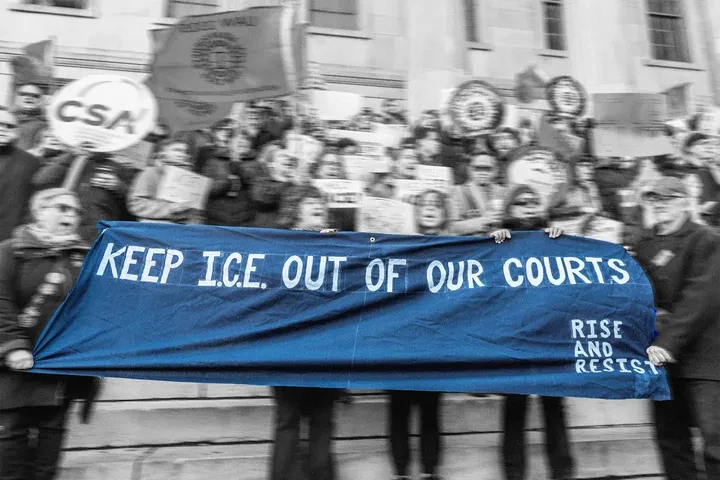
Over the past several weeks, ICE agents have carried out a series of high-profile arrests of immigrants appearing for routine court hearings, core to the administration’s effort to execute what Trump has called the largest deportation campaign in U.S. history.
The guidance change comes as ICE conducts sweeping raid operations across the country, many of which have already ignited mass public protests and fiery clashes between agents and local residents. Critics warn the shift threatens to erode local autonomy and democratic control over law enforcement activity within community boundaries, while further blurring the longstanding line between civil immigration enforcement and criminal law enforcement.
The original interim guidance, issued in January by ICE’s former acting director Caleb Vitello, required agents to confirm that proposed courthouse arrests were “not precluded by laws imposed by the jurisdiction in which enforcement actions will take place.” Current acting ICE director Todd Lyons issued a superseding memo dated May 27 that removes all language requiring adherence to local laws and statutes that limit ICE from carrying out “enforcement actions” in or near courthouses.
“The old policy required ICE to consult with a legal adviser to determine whether making an arrest at or near a courthouse might violate a nonfederal law. The new policy eliminates that requirement entirely,” says Anthony Enriquez, vice president at RFK Human Rights, a human rights advocacy nonprofit. “Now, these frequently complex legal questions fall to the judgment of a frontline line officer who has no specialized training in local laws.”
“It is certainly yet another effort to unleash and expand ICE's enforcement operations without regard to state law,” says Emma Winger, deputy legal director at the American Immigration Council.
While federal policy guidance is not formally legally binding, it carries the practical force of law, setting mandatory procedures that ICE agents must follow when carrying out enforcement operations.
In response to a request for comment, ICE spokesperson Mike Alvarez referred WIRED to the May 27 memorandum. ICE declined to clarify whether it would continue to consider local courthouse policies and security protocols during future enforcement actions.
Vitello, who oversaw issuing the original guidance, was appointed ICE acting director by President Donald Trump shortly after his second inauguration. Vitello was removed from the role in late February and reportedly transferred to oversee the agency’s deportation operations. Lyons assumed the acting directorship in March.
The Biden administration previously limited ICE enforcement actions in and around courthouses in 2021, noting that arrests — which spiked during Trump’s first term — “had a chilling effect on individuals’ willingness to come to court or work cooperatively with law enforcement.”
Current ICE policies continue to advise agents to “generally avoid” actions around courts focused on civil matters — the vast majority of immigration cases are civil in nature — without authorization from a high-ranking supervisor. However, under the Biden-era framework, such actions could only be taken at any court to resolve a national security matter or to prevent threats to public safety or the destruction of evidence material to a criminal case. The Biden-era policy was itself a response to 2018 guidance issued under Trump’s first term, which directed ICE to prioritize arresting migrants at local courthouses.
Last month, shortly before Lyons finalized the policy change, Trump deputy chief of staff for policy Stephen Miller and Department of Homeland Security Secretary Kristi Noem reportedly ordered ICE to deport 3,000 people per day, per Axios — a drastic increase over the deportation rates of Trump’s first administration.
Earlier this week, Lyons defended his agents’ use of masks to hide their identities following a confrontation with citizens outside the Buona Forchetta restaurant in San Diego, California. Bystander videos of the event captured agents deploying flash-bang-type devices to disperse the crowd of protesters, who can be overheard calling the masked agents “Nazis” and “fascists.”
Winger explains that ICE has long made arrests inside state courthouses without regard for state law. Agents often use public court dockets, for instance, to locate migrants scheduled to appear in court, facilitating targeted arrests.
Last month, ICE agents arrested at least a dozen immigrants as they arrived at New York City courthouses for scheduled hearings — including a Bronx high school student. Under New York State law, federal immigration authorities are barred from making civil arrests in and around state courthouses without a judicial warrant. The law does not, however, restrict ICE from making arrests in federal courthouses, where immigration and asylum hearings are typically held. The City of New York on Monday sued Lyons and ICE, as well as DHS and Noem, over the Bronx student’s arrest in an effort to secure his release.
Winger expects the May 27 policy shift will impact states such as Colorado that have enacted similar protections against courthouse immigration arrests.
Last week, DHS published a list of so-called sanctuary jurisdictions that includes dozens of cities and counties that DHS said were not compliant with federal law. The effort was seemingly part of an initiative to push back against municipalities it believes are obstructing its immigration goals. On Sunday, after widespread pushback from local governments, DHS removed the list from its website.
“This policy memorandum change is another attack from the Trump administration against state and local laws that enact across-the-board limits on civil arrests in sensitive locations like schools, churches, hospitals, and courthouses,” adds Enriquez. “In the future, we should expect to see legal challenges to the federal government's encroachment on state sovereignty. And in the meantime, we should also expect to see less access to justice in our local and state courts.”